


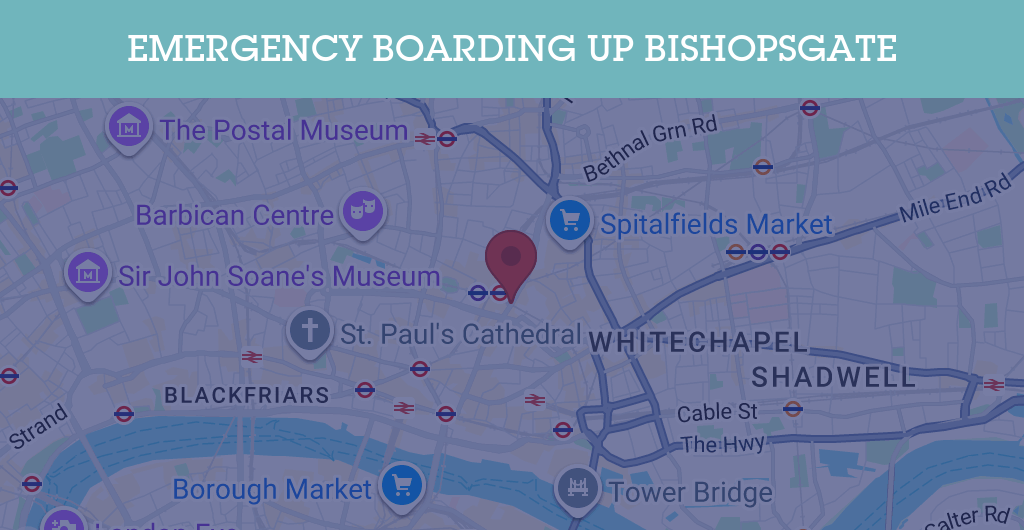
Boarding Up Bishopsgate (E1) – Emergency Property Security in East London
If you need boarding up in Bishopsgate (E1), it’s usually because something has just happened— a smashed window, a forced entry, or damage that can’t safely be left overnight. Bishopsgate sits on the edge of the City and spills into busy parts of East London, with a mix of offices, flats above commercial units, and high-footfall streets that don’t really “switch off” after 5pm.
Boarding Up East London covers Bishopsgate and the E1 postcode district with 24/7 boarding up for urgent call-outs. We don’t promise a fixed arrival time (traffic, access and workload all vary), but we do prioritise emergencies and we’ll give you a realistic ETA on the phone when you call.
Our technicians are DBS-checked, we’re fully insured, and we’ve been trading for 10+ years. Whether you need to board up a broken window, board up a door, or get a commercial frontage made safe after impact damage, the goal is the same: secure the property, reduce further loss, and leave you with clear documentation for your insurer or managing agent.
Need help now (Bishopsgate / E1)? Call 020 4634 6384
Why boarding up matters in Bishopsgate (E1)
Bishopsgate has a few local realities that make temporary boarding more than just a “nice to have”:
High footfall, long hours, and opportunistic damage
Around Liverpool Street Station and the Bishopsgate corridor, there’s constant movement—commuters, deliveries, late-night venues, and weekend traffic. When a window is broken or a door has been forced, the property can attract attention quickly. Even if the initial incident is over, the risk of a second attempt goes up once an opening is visible from the street.
Mixed-use buildings and tricky access
E1 properties here are often mixed-use—commercial at street level with flats or offices above. That can create access problems (shared entrances, concierge procedures, restricted loading bays), and it can make a straightforward “board it from the inside” job less straightforward. We plan fixings around real-world constraints like:
- Internal access limitations (tenant not on site, management holding keys)
- Fragile or historic frames that can’t take aggressive fixings
- Upper-floor windows requiring safe access planning and (where needed) specialist equipment
Commercial glazing and shopfront exposure
Bishopsgate includes plenty of glass-fronted units—reception areas, retail frontages, and office glazing. When large panes crack or fail, it’s not just about security: it’s about public safety, preventing further glass fall, and reducing weather exposure until replacement glazing is arranged. This is where anti-tamper fixings and correctly sized sheeting really matter—especially for street-facing elevations.
Busy roads and impact risk
With heavy traffic and deliveries moving through main routes, impact damage does happen: a vehicle clip, a delivery incident, or street furniture pushed into glazing. Even a “small” crack can become a full failure overnight with temperature changes and vibration—so boarding up quickly can prevent a bigger (and costlier) break.
A typical Bishopsgate call-out (example scenario)
A typical emergency boarding up call in Bishopsgate might involve a property manager reporting a smashed window on a street-facing frontage not far from Liverpool Street Station. The glass may already be partially removed by security, but the opening is exposed and the premises needs to be made safe before staff arrive in the morning.
On arrival, we’d usually:
-
Assess the opening and the frame
- Check whether the surrounding frame is sound enough for non-destructive fixings
- Identify loose glass, sharp edges, and whether the remaining glazing is under tension
-
Choose the right boarding method
- For many commercial openings, we’ll use 18mm exterior-grade plywood for strength and stability
- For smaller or more sheltered apertures, OSB may be appropriate, but we’ll explain the trade-offs (OSB can be cost-effective but isn’t always the best choice for highly exposed street-facing fronts)
-
Install with security in mind
- Where the board is externally accessible, we’ll typically use anti-tamper fixings to reduce the chance of removal from outside—particularly important if the building will be unattended
- If the frame is too damaged to fix into safely, we’ll talk you through options before proceeding (for example, bracing strategies or alternative temporary security measures)
-
Leave clear handover details
- Time-stamped photos of the secured opening
- An itemised invoice and a brief work statement suitable for insurers/agents
- Notes on any frame damage we observed that could affect glazing replacement
The outcome is simple: the opening is secured, the site risk is reduced, and you have the paperwork needed to move the next stage along (glazing, locksmithing, or repairs).
What to do in an emergency in Bishopsgate (E1)
When something’s just happened, it’s hard to think clearly. These steps help you protect people first, then the building, then your claim.
-
If there’s a crime in progress or immediate danger, call 999 If someone is still on site, or the situation is unsafe, don’t confront anyone. Move to a safe place and let the police handle it.
-
If the damage is dangerous (glass, hanging frames), keep people away In busy Bishopsgate areas, passers-by can wander close without realising. If you can do so safely:
- Keep staff/tenants back from the opening
- Don’t try to clear embedded glass with bare hands
- If you have access to cones/tape (many commercial sites do), use them to create space
-
Document before anything changes (if safe) Insurers often want “what happened” evidence. Useful documentation includes:
- Photos of the overall scene and close-ups of the damage
- Any tool marks, forced entry points, or impact direction
- A note of the time you discovered it and who was present
- If police attend, keep the crime reference number
-
Call us to secure the property Tell us:
- Whether it’s a broken window, a door that won’t close, or a shopfront issue
- Whether the opening is at street level or above
- Any access instructions (concierge, loading restrictions, keyholder contact)
We’ll advise what we need from you and give an ETA based on current conditions.
-
Contact your insurer or property manager We’re not loss adjusters, but we can provide the documentation insurers typically request. If you’re a tenant, notify your landlord/managing agent quickly—especially in mixed-use buildings where the freeholder may have rules about temporary works.
Our local coverage around Bishopsgate
We cover Bishopsgate in E1 and nearby East London areas that often overlap in real-world call-outs (for example, where a property sits close to boundary lines or where keyholders are based).
Nearby pages you may also find useful:
If you’re unsure whether your location counts as Bishopsgate or a neighbouring pocket, call anyway—if you’re in E1, you’re within our core patch.
Bishopsgate FAQs (E1)
How quickly can you attend in Bishopsgate (E1)?
Attendance depends on traffic, access, and current emergencies in the queue. We prioritise urgent jobs and will give you a realistic ETA on the phone. If you’re near a major route or by Liverpool Street Station, congestion and loading restrictions can affect arrival and parking—tell us what the access is like so we can plan.
Can you board up a shopfront near Bishopsgate even if the shutter is damaged too?
Yes—boarding up can still be the correct “make safe” step even when shutters are compromised. The immediate goal is to close off the opening and reduce risk of entry. If there are multiple vulnerabilities (glazing + shutter + door), we’ll talk through the most security-critical first steps.
I’m in a managed building—do you need permission from the freeholder or concierge?
Not always, but it helps to clarify before we arrive. Some buildings have strict rules around temporary works to communal areas or front elevations. If you can, get confirmation from the managing agent/concierge and ensure someone can provide access. If permission is unclear, we can still advise on non-invasive options where appropriate.
Will boarding damage the window frame or stonework on older buildings around Bishopsgate?
We aim to secure openings with methods that balance strength and minimising further damage. That said, if the surrounding structure is already compromised (rotted timber, cracked masonry, loose render), any fixing approach has limitations. If the frame is too fragile for standard fixings, we’ll explain options before proceeding rather than guessing.
Do you provide paperwork for insurance claims for E1 properties?
Yes. You’ll typically receive time-stamped photos and an invoice with a clear description of works carried out. Keep your insurer’s claim reference and (if relevant) the police reference number. We can’t decide what your insurer will cover, but we can support the process with the documentation they usually ask for.
Can you secure upper-floor windows in Bishopsgate offices or flats?
Often, yes—subject to safe access. Upper-floor work may require internal access, landlord permission, or specialist equipment. Tell us the floor level and whether there’s safe internal access to the window. If access isn’t safe or permitted, we’ll be upfront about what can and can’t be done immediately.
What if the door has been forced and won’t shut properly?
If you can’t lock the door, the property isn’t secure. We can board up the doorway as a temporary measure and advise on next steps. If the frame is split or the lock area is torn out, it may need a stronger temporary solution than a basic board—we’ll assess on site and explain the options.
Need boarding up in Bishopsgate (E1)?
If you need to secure a property after damage—whether it’s a board up broken window, a board up door, or an out-of-hours shopfront boarded up job—call us and we’ll talk you through the safest next step.
Need help now? Call 020 4634 6384 for 24/7 assistance in Bishopsgate (E1). If you can’t stay on the line, ask for a callback and we’ll return your call as soon as possible.
